
SEO and AI audit: what a report must tell you, and what it will never say.
Before redoing a website or paying for ads, an audit tells you where you are losing customers — on Google, and now in AI assistants. How to read a score out of 100, what a free audit is worth, and the traps to avoid.
Published on
Before redoing a website or paying for ads, an audit tells you where you are losing customers — on Google, and now in AI assistants. How to read a score out of 100, what a free audit is worth, and the traps to avoid.
Why measure before you spend
We often get the same call: “My website brings nothing, I want to redo it.” Sometimes that is true. Often the site is fine and something else is blocking: a title that does not say the trade, a Google profile not linked, a page that takes six seconds to open on a phone. Redoing the site would have fixed nothing.
An audit is the site visit before the work. We look at what is there, we measure, we name the leaks. It costs less than a redesign, takes less time than an ad campaign, and keeps you from paying for the wrong problem.
The four measures that matter
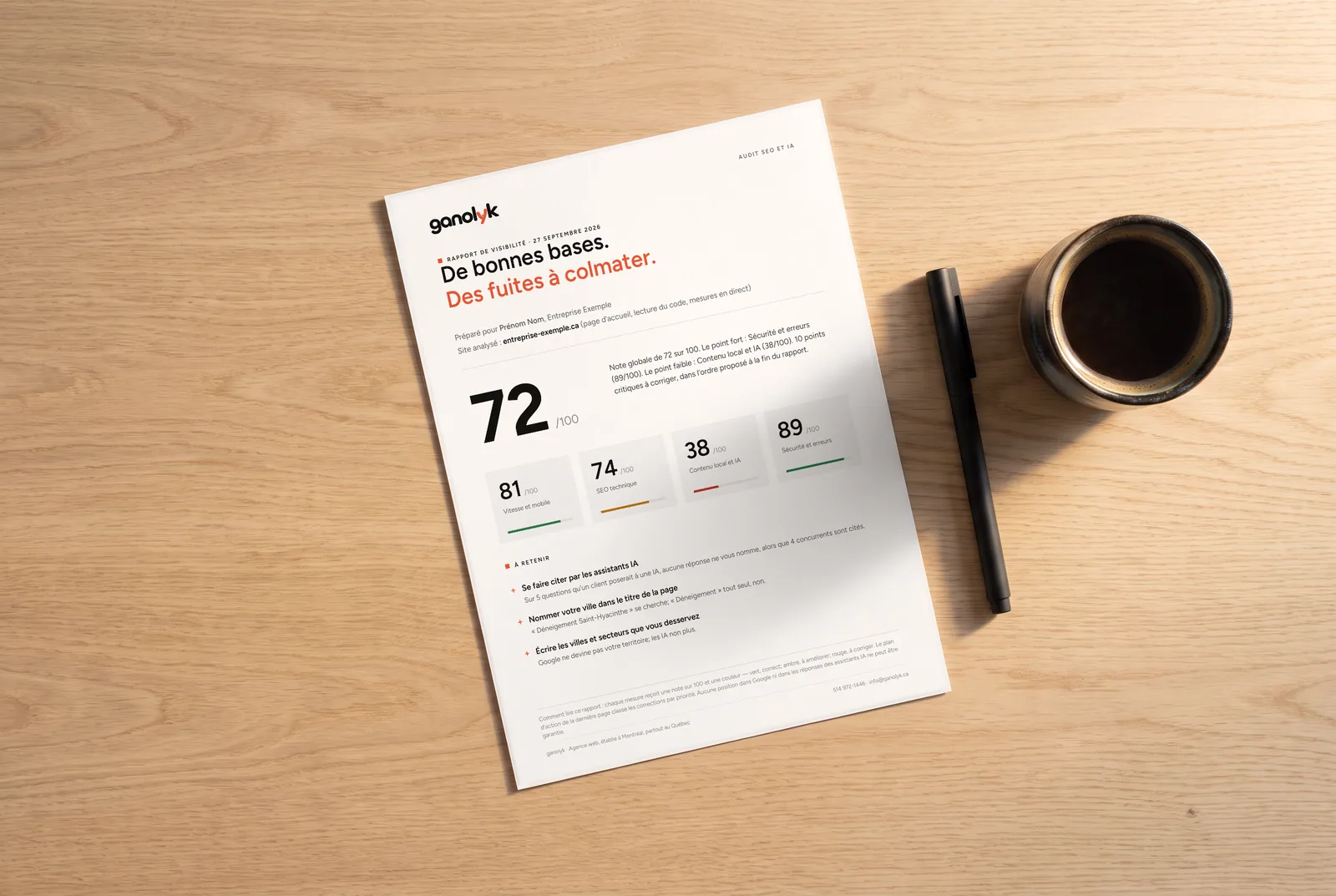
A good report does not drown you in two hundred lines of jargon. It groups what matters into a few measures, each with a score and an everyday-language explanation. Ours has four.
- Speed and mobile: load time on a phone, on cellular data, not on the office wifi. Google measures it; your customers feel it.
- Technical SEO: titles, descriptions, sitemap, indexing, structured data — everything that lets Google understand your pages.
- Local content and AI: your city, contact details and services spelled out, your social profiles linked to the site, and the signals AI assistants read.
- Security and errors: HTTPS, redirects, broken links, the 404 page. The warnings that scare people off before they even read.
If an audit only talks about one of these four — usually speed, because it is easy to measure — it shows you a quarter of the picture.
The new question: does AI cite you?
Two years ago the only question was “do I show up on Google?”. Today, part of your customers ask ChatGPT, Perplexity or Google’s AI first: “who do you recommend for a French drain in Candiac?”. The assistant answers with three names and their websites. If you are not among them, you do not exist for that person.
That is what GEO means — Generative Engine Optimization. A serious audit now measures it: we ask an AI assistant five real customer questions and look at who it cites. The result is often blunt — “cited in 0 of 5 answers, 4 competitors cited instead” — but it is the kind of number that gets things moving.
The good news: what AI assistants cross-check before recommending you is the same foundation as Google. A clear site that says who you are, where you are and what you do, with a Google profile and reviews. You do not have two jobs to do; you have one.
How to read a score out of 100
A 72 out of 100 is not a school grade. It is a starting point, at a given date, on the home page. What counts is the colour of each line: green is fine; amber deserves a nudge; red is costing you customers. And the order in which the report ranks the reds.
Beware of reports that give everyone 34 out of 100. Some tools are tuned to scare: every detail becomes a “critical error”, and the solution, as it happens, is the $3,000-a-month package. An honest audit also says what is going well.
What a free audit will not tell you
Ours is free, and we are upfront about this: it tells you where things break, not how to repair everything. That is not sales restraint, it is honesty. A real correction plan means reading all your pages, not just the home page; comparing your actual competitors; choosing your keywords; and ranking the fixes by effort and by payoff.
That is what the complete report contains — free if you take 20 minutes to go over it with us, or $99 if you would rather just receive it, credited toward a project if you continue with us. And you do not have to continue with us: the plan stays yours, your current provider can apply it, or you can, one line at a time.
The traps to avoid
- The audit that arrives unasked. The email saying “we found 47 errors on your website” is an ad, not a diagnosis.
- The audit that only looks at speed. A fast site that does not name your city stays invisible.
- The audit that promises a ranking. Nobody can guarantee a position in Google or in an AI’s answers. Those who promise it are selling something else.
- The audit without a plan. A list of problems with no order is a grocery list. Ranking by priority is what saves you time.
Where to start
- Today: request an audit — ours takes two minutes to fill in and arrives by email as a PDF.
- This week: read the red lines and ask yourself one question: are my trade and my city spelled out on my home page?
- This month: decide who applies the fixes — you, your provider, or us — and in what order.
- In six months: run the audit again. The number that matters is the one that moved.
None of this is magic. But a site where the reds are fixed, one by one, starts ahead of most of the sites we see — on Google as well as in AI assistants.
Want to know where you stand? The SEO and AI audit is free: enter your website address, and the report reaches your inbox within minutes.